Subterranean termite activity in Minneapolis centers primarily on moist structural wood contacting soil or subterranean masonry foundation walls. In historical neighborhoods like Linden Hills, Whittier, and Longfellow,…
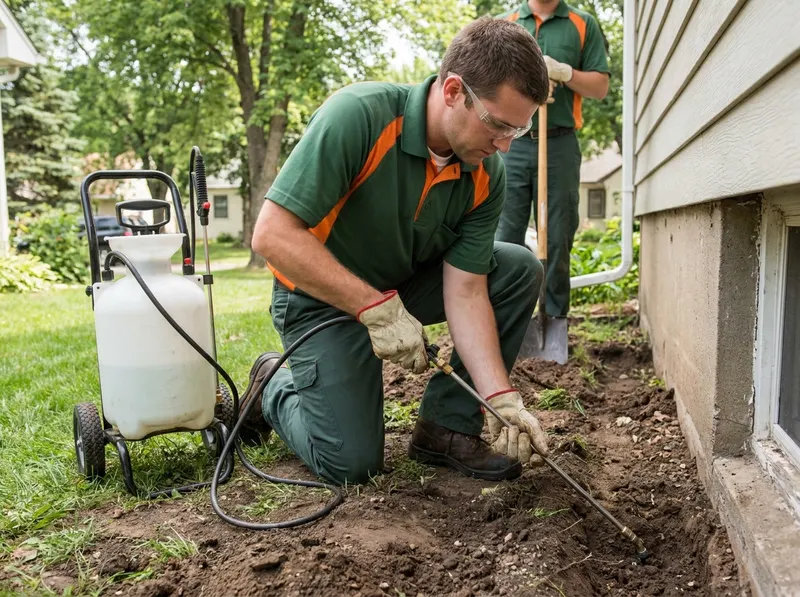
Subterranean termite activity in Minneapolis centers primarily on moist structural wood contacting soil or subterranean masonry foundation walls. In historical neighborhoods like Linden Hills, Whittier, and Longfellow, century-old stone, limestone, and poured-concrete foundations settle, opening fractional stress cracks under 1/16 of an inch wide. Subterranean termites construct subterranean mud tubes through these foundation fractures, seeking structural sills, rim joists, and subfloors. Soil barrier treatments inject non-repellent liquid termiticides directly into the exterior foundation trench to a depth of 4 to 6 inches, binding to backfill soil particles. Foraging termites encounter the undetectable barrier without avoidance, carrying active agents back into subterranean colonies to neutralize workers and reproductive queens.
Selecting a liquid soil barrier involves clear mechanical distinctions against localized spot treatments or surface bait systems. A continuous liquid soil perimeter provides uninterrupted boundary exclusion beneath the soil surface, blocking insects from shifting laterally to an untreated foundation void. The operational trade-off centers on site preparation: exterior concrete porches, attached garages, and paved sidewalks in high-density areas such as North Loop and Uptown require precision slab drilling at 12-inch intervals to reach the concealed soil footing, followed by aggregate-matched masonry patching. While bait monitoring systems eliminate the need to drill through exterior concrete, baiting relies on delayed feeding timelines of 60 to 180 days; liquid barriers establish immediate structural exclusion on day one.
Hennepin County soil dynamics directly dictate termiticide performance. Glacial outwash sands along the Mississippi River Gorge and sandy loams near Powderhorn Park, Lynnhurst, and Bryn Mawr drain moisture rapidly, requiring specific volume-calibrated injection rates to ensure continuous coverage down to structural footings. In Northeast Minneapolis properties with finished basements, treatments address both exterior foundation walls and interior critical points around main sewer cleanouts, water supply pipes, and basement expansion joints. Integrated treatments remain isolated within external soil zones, eliminating chemical exposure inside living quarters and ensuring safe occupancy for children and domestic pets once external soil settles.
Every job gets a firm, written price after a free on-site visit.
Tell us about your subterranean termite soil barrier treatments job in Minneapolis and we'll send a clear, written quote, usually the same day.
 Crovella Bug Services